

.jpg)
Introduction
ABN AMRO launched a multi-country initiative to harmonise reporting systems, workflows, and documentation across the Netherlands, France, Belgium, and Germany. Although the reports looked simple on the surface, each country used different logic, tooling, approvals, and documentation standards — resulting in inefficiencies, inconsistent outputs, and slow onboarding of new team members.
My role combined business analysis, product ownership, process optimisation, and light engineering to professionalise reporting processes, create one unified way of working, and strengthen collaboration between Business Intelligence, IT, and international stakeholders.
The Core Problem
During the assessment one thing was clear:
every country worked differently, documentation was fragmented, and knowledge lived inside individual teams — making the reporting landscape slow, error-prone, and difficult to scale.
Key issues:
- No harmonised reporting framework across countries
- Outdated or missing documentation for key reporting logic
- Slow onboarding due to lack of structure, unclear workflows, and inconsistent standards
- Reporting logic duplicated in different ways across teams and regions
- No central knowledge base — expertise was tribal knowledge
- Limited UX consistency in internal reporting dashboards
- Inefficient communication between business & technical teams
These gaps resulted in slow change cycles, reporting inconsistencies, higher operational costs, and onboarding times that stretched far too long.

Discovery & Research
To redesign the way of working, I performed a full discovery across business, BI, and IT:
Cross-country stakeholder research
- Interviews with Business Intelligence teams in NL, FR, BE, and DE
- Deep-dive into how each region handled reporting requests, logic, and documentation
- Identified duplicated work, mismatched expectations, and inconsistent reporting logic
Process & workflow mapping
- Mapped end-to-end reporting workflows (change → approval → implementation → communication)
- Highlighted bottlenecks slowing down changes and onboarding
- Analysed approval flows and translation points between business & technical teams
Technical deep-dive
Conducted a complete review of the underlying reporting architecture to understand how data transformations, calculations, and visual outputs were structured — enabling me to translate complex backend logic into clear, standardised requirements.
This ensured that business, BI, and developers all worked from one unified interpretation of the truth.
Knowledge base & training
- Created a central Confluence knowledge base including changelogs, documentation standards, UI/UX guidelines, functional instructions, and reporting logic
- Built a structured documentation model so future changes were consistent and traceable
- Designed and delivered training sessions for new team members internationally — becoming recognised as a key knowledge holder for Triple A scripts, reporting logic, and documentation standards
What I delivered
Process Harmonisation & Reporting Structure
- Designed a unified reporting framework used across all participating countries
- Standardised the change request process with clear approvals, risk assessment, and documentation flows
- Improved UI/UX of internal reporting dashboards to increase readability and trust
- Reduced reporting inconsistencies by aligning logic, naming conventions, and data definitions
Documentation & Knowledge Management
- Built a complete Confluence knowledge environment serving as the single source of truth
- Converted fragmented documentation into structured, versioned, and searchable knowledge
- Standardised templates for documentation, changelogs, functional instructions, and technical notes
- Ensured future onboarding would rely on structured knowledge, not individuals
Collaboration & Communication Upgrade
- Strengthened collaboration between business & IT with clear communication patterns and aligned expectations
- Acted as the bridge between business analysts, BI specialists, and developers
- Created a transparent workflow for reporting changes and technical adjustments
Business Results
- 50% faster onboarding of new BI and reporting team members, enabled by the structured Confluence knowledge base I built and the training sessions I delivered across all four countries.
- Teams became far more independent, thanks to my hands-on knowledge transfer on reporting logic, documentation standards, and Triple A scripting.
- Higher reporting accuracy and consistency across NL, FR, BE, and DE due to one harmonised reporting framework and clear documentation standards.
- Faster, more predictable change cycles, supported by unified approval flows, clear requirements, and transparent communication between business, BI, and IT.
- Reduced operational friction — fewer escalations and less rework, as teams could rely on a single source of truth instead of fragmented local documents.
- Strengthened collaboration across business & IT, as aligned expectations and shared understanding replaced the previous siloed way of working.
Outcomes & Impact
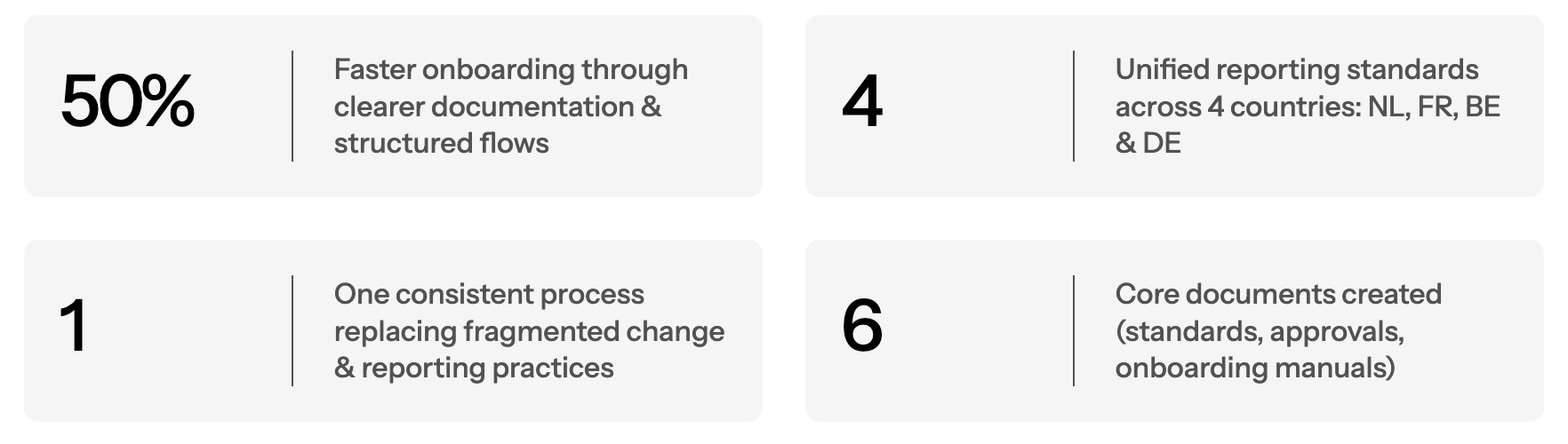
This project strengthened the foundation of ABN AMRO’s international private banking reporting landscape. By unifying reporting logic, centralising documentation, and training teams across four countries, the organisation moved from scattered, inconsistent processes to a streamlined, scalable, and knowledge-driven way of working.The result is a reporting ecosystem that supports faster client onboarding, higher data quality, and smoother collaboration between business, BI, and IT.