


Introduction
The ALD × LeasePlan merger spanned 50+ countries across Europe, the Middle East, Africa, Asia-Pacific, Oceania, and North & South America.
Each market operated with its own systems, documentation practices, and delivery maturity — resulting in fragmentation, inconsistent reporting, and no unified visibility across the merger.
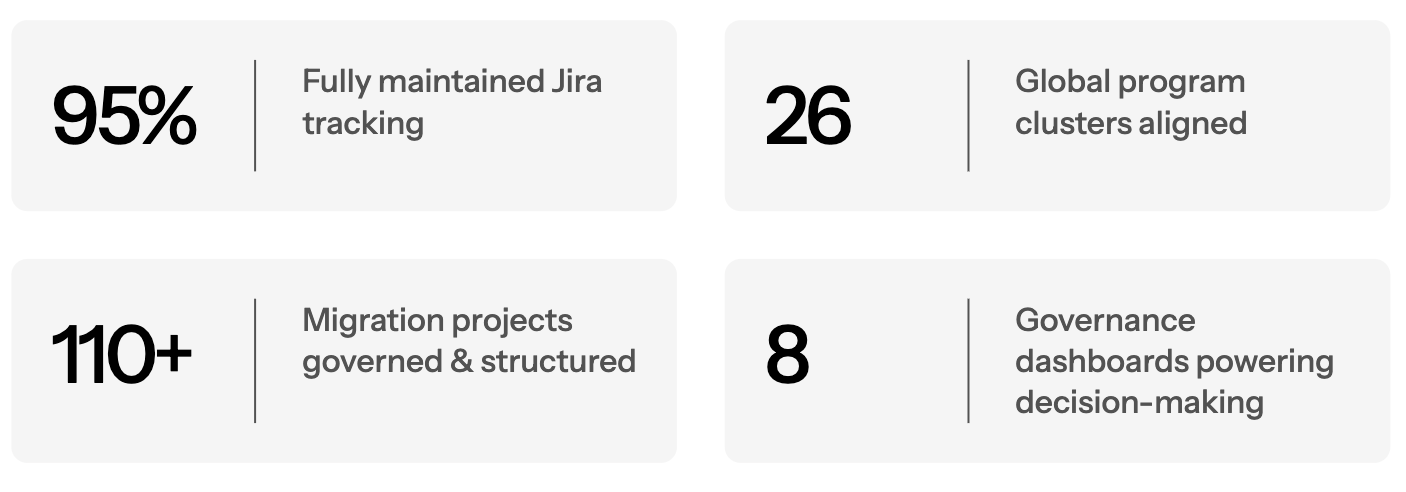
As part of the Global Program Project Management team, I built the merger-wide governance, reporting structure, and delivery ecosystem. And aligned 26 global program clusters, standardized Jira and Confluence, and created full transparency across one of the largest automotive mergers in Europe.
The Core Problem
The merger faced several critical challenges:
- 50+ countries, each with different systems and operational structures
- 26 program clusters, all reporting differently
- No unified visibility of risks, issues, blockers, or dependencies
- Fragmented documentation across Confluence and offline files
- Low Jira adoption (~30% accuracy)
- No leadership dashboards
- No single view on 800+ application touches
- No structure for decisions, escalations, or reporting cadence
- Program Managers resisted structured reporting due to workload, unclear expectations, and inconsistent previous processes
Leadership required a governed, transparent delivery system that worked across all clusters.

Discovery & Research
Mapping Cluster Landscape Analysis
- Mapped all 26 program clusters (Finance, Data, Security, Insurance, Fleet, Salesforce, Marketing, Procurement, HR, etc.)
- Identified gaps in documentation, tracking, and reporting
- Assessed delivery maturity and readiness levels
Application Touch Analysis
- Documented 800+ application touches across countries
- Linked each touch to its responsible cluster for migration oversight
- Provided the first structured overview of migration impact
Reporting Gaps Assessment
- Found missing owners, outdated information, and incomplete Jira updates
- No decision-tracking structure existed
- No exception process existed
- Identified resistance from Program Managers and wide differences in working methods
These insights shaped the governance model and accountability framework I built.
What I Delivered
Merger-Wide Governance Framework
I designed a predictable governance and reporting system across all clusters:
- Standardized cadence and Ways of Working
- Cross-cluster alignment rituals
- Unified documentation approach in Confluence
- Clear ownership definitions and escalation paths
Weekly “Ways of Working” Sessions (Key Success Factor)
To overcome resistance and drive reporting discipline, I introduced weekly structured sessions per cluster where:
- Power BI dashboards were shared transparently
- Progress and gaps were reviewed live
- Each cluster saw their performance vs others
- Underperformance became visible — creating natural accountability
This weekly cycle became the engine for predictability and alignment.
Jira Ecosystem — 110+ Projects Built & Structured
I designed and implemented the entire Jira structure across the merger:
- Built & structured 110+ Jira projects
- Created unified templates for epics, rollouts, initiatives, deliverables
- Standardized tracking for:
- risks
- issues
- blockers
- dependencies
- cross-cluster dependencies
- milestones
- start/due dates & ownership
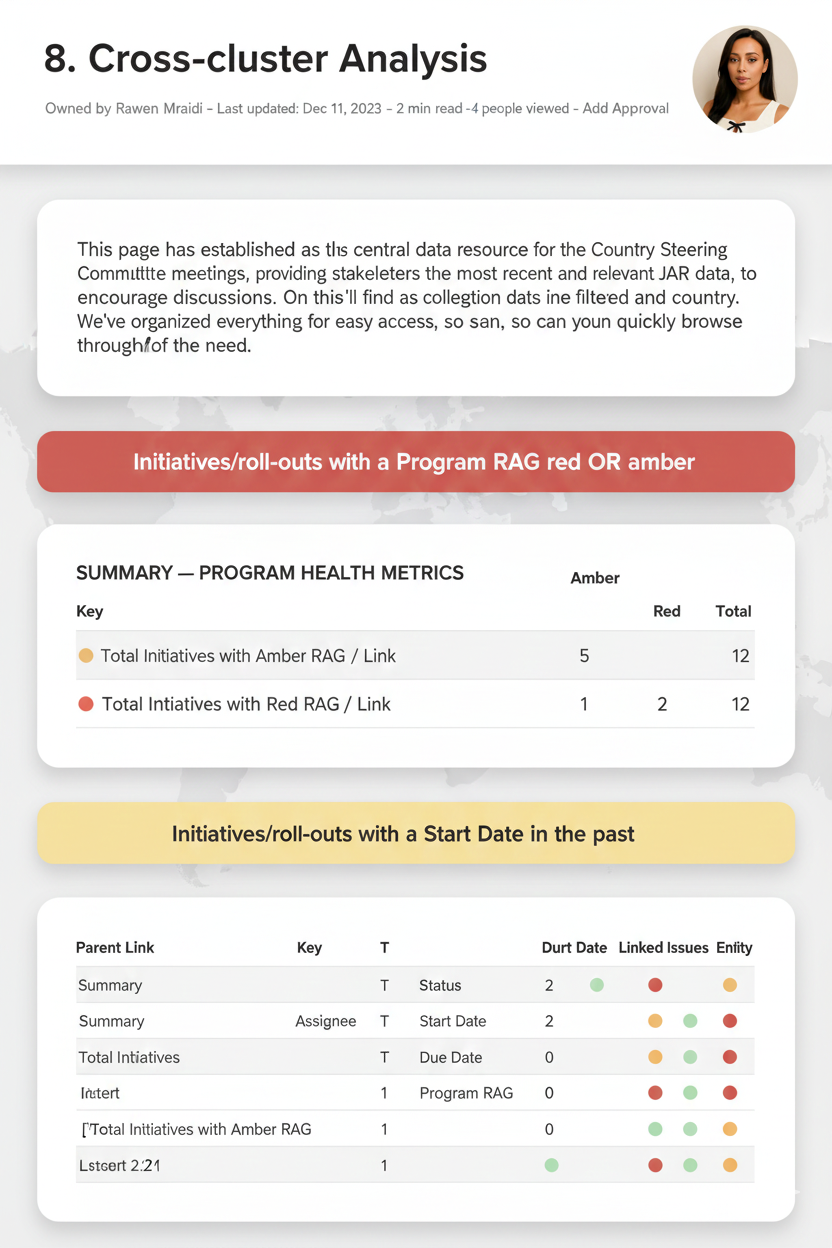
- Implemented a global RAG status model
- Trained Program Managers in consistent reporting
Driving Accountability With Data
Because many Program Managers initially resisted updating Jira:
- I built per-cluster performance scoring (data hygiene dashboards)
- Measured % of:
- valid dates
- assigned owners
- missing risks/dependencies
- unresolved issues
- overdue work
- incomplete updates
These metrics were reviewed weekly in the governance sessions.
Result: Jira update accuracy increased from 30% → 95% in only 2 weeks.
Transparency created accountability — and performance transformed.
Leadership Dashboards (Power BI)
I delivered Power BI dashboards that became the single source of truth for leadership.
The dashboards visualised:
- Overall cluster health
- Country readiness for rollout
- Risk heatmaps & severity
- Dependency impact & cross-cluster bottlenecks
- Milestone tracking & delayed items
- 800+ application touch insights
- Overdue work & escalation triggers
- Real-time visibility of decisions & exceptions
Data Hygiene Dashboard (critical for discipline)
Measured per cluster:
- % projects with valid start/due dates
- % tasks with assigned owners
- % missing risks/dependencies
- % unresolved issues
- % incomplete or late updates in Jira
Delivered an objective performance score per cluster, enabling leadership to act immediately on gaps.
My Governance Innovations (Used Across All Clusters)
Exception List
Introduced to highlight:
- missing due dates
- missing owners
- overdue items
- clusters at risk
- delayed rollouts
- inconsistent reporting
It became a core accountability tool.
Decision Log
- capture all key decisions across clusters
- document reasoning & ownership
- eliminate duplicated conversations
- provide long-term auditability
- build alignment between ALD & LeasePlan teams
It became a foundational governance element.
Business Results
- A fully governed delivery model across 26 global clusters
- Predictable delivery planning across 50+ countries
- Real-time transparency for leadership
- Standardized reporting across the merger
- Accountability built into the operational model
- Jira accuracy raised from 30% → 95% in 2 weeks
- Cross-cluster alignment and structured decision-making
- The first complete, reliable operational view in the merger
Outcomes & Impact
Closing Thoughts
The NovaBank redesign made finance less intimidating and more actionable.
Users can now manage their finances confidently while the bank enjoys higher adoption and retention.