

.jpg)
Introduction
Red Star, one of the leading tomato producers in Europe, struggled with major planning inefficiencies driven by inaccurate production forecasts. These inaccuracies had a high operational and financial impact across the entire chain — from crop management to labour planning, packaging, logistics, and customer delivery.
I was brought in to untangle the forecasting process, quantify the root causes, redesign the workflow, and deliver a process +software recommendation that would enable Red Star to scale with accuracy, stability, and efficiency.
The Core Problem
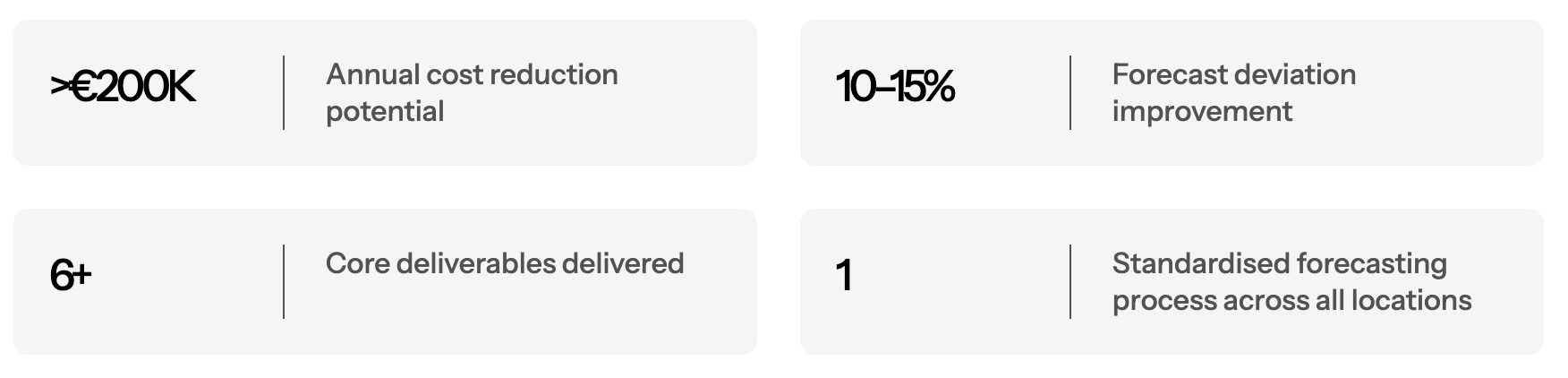
Forecasts deviated 10–15% from actual yields — while the business required a maximum deviation of ≤5%.
This created a cascade of problems:
- Overproduction → product waste, unnecessary labour and packaging costs
- Underproduction → shortages, missed orders, penalties, reputational damage
- Incorrect labour planning → too many employees on slow weeks, too few during peak loads
- Decisions driven by gut feeling instead of data
- No unified forecasting standard across locations
- No dedicated tool to support accurate, multi-variable forecasting
- Limited transparency into where and why forecasts failed
This was not a small data issue, but an operational bottleneck.


Discovery & Research
I approached the problem through an end-to-end analysis combining process architecture, data modelling, operational observation, and tooling evaluation.
1. End-to-End Process Mapping (BPMN)
- Modelled the full forecasting, planning, and decision process: from climate inputs to harvest, labour planning, and weekly production meetings.
- Uncovered blind spots, timing inconsistencies, and undocumented dependencies in the forecasting workflow.
2. Deep Data & Deviation Analysis
- Analysed historical yield and forecasting data using SQL.
- Quantified deviation patterns per crop variety, greenhouse, season, and location.
- Identified systemic error drivers (timing issues, input variability, climate distortions, manual overrides).
3. Operational Reality Check — On-Site Analysis
- Visited production facilities to observe the actual workflow behind forecasting inputs.
- Validated where the process broke down in practice, not just on paper.
4. Root-Cause Structure
- Mapped 18+ root causes using the 5-Why method and fishbone modelling.
- Connected each root cause to measurable operational consequences (waste, shortages, labour inefficiencies).
5. Stakeholder Alignment Across Departments
- Interviewed growers, planners, operations managers, and sales teams.
- Consolidated conflicting expectations into one shared problem statement and one unified improvement direction.
6. Software Market Scan
- Created a requirement framework covering functional, operational, and technical needs.
- Evaluated multiple forecasting tools based on accuracy models, integration capability, UX, scalability, and ROI.
- Delivered a shortlist with clear recommendations for executive decision-making.
What I Delivered
A full transformation blueprint:
- Complete AS-IS process architecture (BPMN) for forecasting and planning
- Structured root-cause analysis covering operational, data, climate and timing factors
- Forecast deviation model quantifying where and why errors occurred
- Lean improvement proposals to stabilise inputs and reduce planning variability
- Software requirements document for forecasting and planning tools
- Validated shortlist of solutions with vendor insights and fit-gap analysis
- Business case with ROI, cost scenarios, risk assessment, and expected waste reduction
- Implementation roadmap for process standardisation and tool deployment
Business Results
>€200K annual cost reduction potential
From eliminating structural oversupply, waste and unnecessary labour hours.
Significant reduction in forecasting deviations
Clear visibility into error drivers enabling targeted optimisation.
Accurate workforce planning
Prevented overstaffing in low-yield weeks and labour shortages during peak production.
Unified forecasting workflow across all production locations
One consistent process replacing fragmented local methods.
Strategic readiness for tool implementation
The business received a clear, validated, and financially grounded software direction.
Cross-team operational alignment
Sales, production, operations, and growers finally worked from one structured model.
Outcomes & Impact
Closing Thoughts
We delivered a custom CRM with a direct API integration to the ERP, giving the business accurate customer data, clear pricing logic, and real margin visibility.This setup now supports higher conversion, better commercial decisions, and scalable revenue growth.